
A beginner gym workout plan doesn't need to be complicated, and it shouldn't be. Three full-body sessions a week, five basic exercises, one simple rule for progressing: that's the format that has turned more beginners into regulars than any six-day split ever will.
This guide gives you that plan, exercise by exercise, plus the part nobody puts in a PDF: how to actually walk into the gym feeling like you know what you're doing.
What actually matters when you start
When you're figuring out how to start working out at the gym, it's tempting to hunt for the perfect program. The honest answer: at the beginner stage, almost any sensible plan works. What separates people who transform from people who quit isn't the program: it's showing up, week after week, for months. Consistency beats perfection, every time.
That's why the proven default is three full-body sessions per week: frequent enough that every muscle gets trained multiple times, spaced enough that you recover between sessions, and light enough on your calendar to survive busy weeks. If you're wondering whether more days would be better, read our guide on how many workouts per week you actually need: for beginners, the answer is usually fewer than you think.
A simple full-body template you can start this week
Here's a gym routine for beginners you can run on Monday, Wednesday and Friday, or any three non-consecutive days. It's a full body workout for beginners built on five movement patterns, and it covers everything that matters:
- Squat pattern : leg press or goblet squat: 2–3 sets of 8–12 reps
- Horizontal push : machine chest press or dumbbell bench press: 2–3 sets of 8–12 reps
- Horizontal pull : seated cable row or machine row: 2–3 sets of 8–12 reps
- Vertical push : machine or seated dumbbell shoulder press: 2–3 sets of 8–12 reps
- Core : plank: 2–3 holds of 20–40 seconds
Rest about 90 seconds between sets; the whole session takes 40–50 minutes. And yes, machines are completely legitimate. They guide the movement path, they're easy to learn, and they let you train hard safely while you build coordination. Real lifters use free weights is locker-room noise: use whatever lets you train consistently.
Leo's tip: for your first two weeks, deliberately pick weights that feel too easy. You're learning movements, not setting records. The weight will come faster than you think.
Gym anxiety is normal (and fixable)
If the thought of walking onto the gym floor makes you nervous, welcome to the club: almost everyone starts there. First thing nobody tells you: experienced lifters are absorbed in their own workout. They genuinely aren't watching you, and the awkwardness you feel is invisible from the outside.
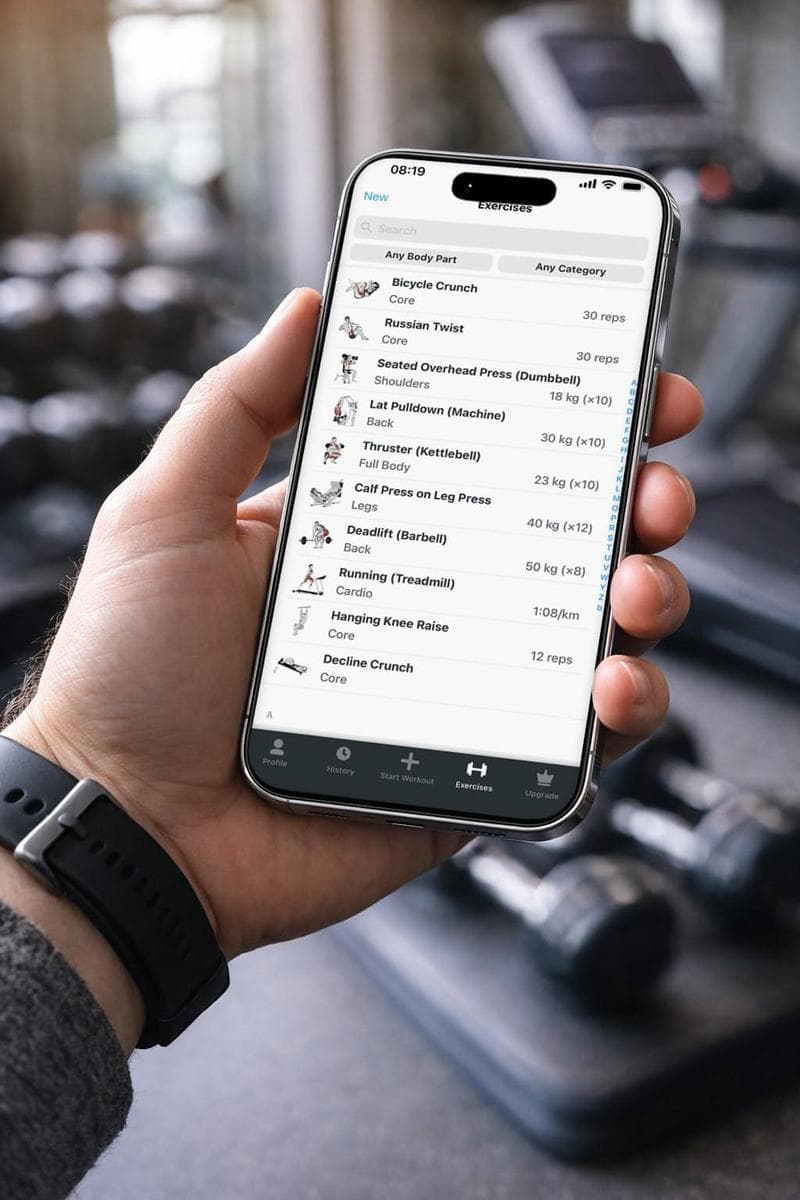
Second thing: most of the anxiety comes from not knowing what to do next. Having your plan on your phone (exact exercises, sets and reps, in order) removes 90% of the stress. You walk in, open the app, do the next thing. For an even softer start, go at off-peak hours: mid-morning or early afternoon, the floor is quiet and the machines are free.
How to progress week to week
A plan only works if it gets gradually harder. That's the principle of progressive overload, and for a beginner it stays beautifully simple: add reps first, then add weight.
Say you're doing the chest press for 3 sets of 8 at 30 kg. Next session, aim for 9 reps per set. Then 10, then 11, then 12. Once you hit 3×12, add a small amount of weight and drop back to 8 reps. Repeat for months. This one rule turns the same five exercises into a program that keeps producing results, but it only works if you know what you lifted last time, so write everything down.
Mistakes that kill beginner progress
Beginners rarely fail because their program is bad. They fail because of one of these:
- Program hopping : switching plans every two weeks because a video promised faster results. Any plan needs 8–12 weeks to show what it can do.
- Ego lifting : loading weight you can't control to impress people who, as covered above, aren't looking. Sloppy heavy reps build less muscle and more injuries than clean moderate ones.
- Skipping rest days : muscle grows between sessions, not during them. Training every day as a beginner is a shortcut to burning out.
- Comparing yourself to others : the person lifting triple your weight has years of training you haven't done yet. The only comparison that matters is you versus last week.
How to start at the gym with fitleo
fitleo was built for exactly this moment. Instead of piecing a plan together from videos, you chat with Leo, your coach, and tell him you're new, how many days you can train, and what your gym has. He builds a beginner-appropriate program on the spot, whether that means machines, free weights or equipment at home.
- Download fitleo and tell Leo you're starting out: your level, your days, your equipment.
- Leo generates a beginner program: the right exercises, sets, reps and rest times.
- In the gym, the app walks you through the session exercise by exercise: no guessing what comes next.
- Log your sets as you go. Logging is free and unlimited.
- Leo adjusts the plan week after week as you get stronger.
Every personal record gets celebrated, and streaks and XP quietly turn I should go to the gym into I'm not breaking my streak. That habit layer is where most beginners win or lose, and it's exactly what a PDF can't give you.
Quick questions
How many days a week should a beginner go to the gym?
Three full-body sessions on non-consecutive days is the sweet spot: enough stimulus to progress fast, enough recovery to avoid burnout. Two sessions still work well if life is busy. More than four is rarely useful in your first months: recovery, not gym time, is usually the limiting factor.
Should beginners use machines or free weights?
Whichever gets you training consistently. Machines are easier to learn, safer to push hard on, and build real muscle, a legitimate long-term choice, not training wheels. Free weights build coordination and are worth learning gradually. Most beginners do best mixing both.
How long until I see results from a beginner gym plan?
Strength improves within the first 3–4 weeks, mostly your nervous system learning the movements. Visible changes typically show around 8–12 weeks with consistent training and reasonable eating. Take a photo when you start: the mirror lies day to day, but not month to month.
Do I need a personal trainer to start at the gym?
No. A clear plan, light starting weights and a little patience cover most of it, and machines have the instructions printed on them. A few sessions with a trainer can be worth it to check your form on free-weight basics, but plenty of people learn well with an app and by filming their own sets.
Keep reading
- Progress5 min read
How Many Days a Week Should You Work Out?
How many days a week should you work out? For most people, 3–4 is the sweet spot. The honest answer by goal, plus full body vs split.
- Tracking5 min read
How to Track Workouts: Build a Log That Drives Progress
Learn how to track workouts the right way: what to log, paper vs apps, and how to read your data, plus a free unlimited workout tracker in fitleo.
- Programs4 min read
Personalized Workout Plan App: Get a Plan Built for You
How a personalized workout plan app builds a training plan around your goal, schedule and equipment, and why it beats generic PDF programs.