
A personalized workout plan app asks about your goal, your experience, your schedule and your equipment, then builds a training plan that actually fits your life instead of forcing you into someone else's template. The best ones keep adjusting the plan as you train, so it never goes stale.
This guide covers what a good personalized plan looks like, what information a plan builder needs from you, and how to tell a genuinely personalized program from a PDF with your name on it.
Why generic workout plans fail most people
Most free programs found online are written for an imaginary average person: five days a week, full gym access, no injuries, endless motivation. Real life rarely cooperates. You miss a Tuesday, the squat rack is taken, your shoulder acts up, and the plan has no answer, so you quit.
Research on exercise adherence keeps pointing to the same thing: people stick to plans that fit their constraints, not the theoretically optimal ones. A decent plan you follow for six months beats a perfect plan you abandon in week three.
Leo's tip: the best program is the one that survives your worst week: plan for the busy weeks, not the ideal ones.
What a plan builder needs to know about you
A serious workout plan builder will collect a handful of inputs before writing a single set. If a tool spits out a plan without asking these, it's a template with your name on it:
- Your goal : building muscle, losing fat, getting stronger, or just staying consistent. Each one changes exercise selection, volume and rest times.
- Your experience level : a beginner progresses on almost anything; an intermediate needs smarter volume distribution.
- Your schedule : how many days per week you can realistically train, and how long each session can run.
- Your equipment : full gym, dumbbells at home, or bodyweight only. A good plan works with what you have.
- Your constraints : past injuries, movements you hate, movements you love. Enjoyment predicts adherence.
What a good personalized plan looks like
Whatever the tool, the output should follow the same principles a competent human coach would apply:
- Compound movements first : squats, presses, rows and hinges drive most of your progress; isolation work fills the gaps.
- Balanced volume : each muscle group hit with enough weekly sets to grow (roughly 10–20 for most people), spread across your available days.
- Built-in progression : a rule for when to add weight or reps, not just a static list of exercises.
- Recovery that matches frequency : no training the same muscle hard on back-to-back days.
If a generated plan has you doing ninety minutes of isolation exercises six days a week as a beginner, close the tab. Volume you can't recover from isn't ambition, it's a plateau with extra steps.
The real advantage: a plan that adapts
The gap between an adaptive plan and a static program isn't the first week: it's week six. A static plan doesn't know you missed two sessions, hit a personal record on deadlifts, or switched to a hotel gym. An adaptive one takes that into account and rewrites what's next.
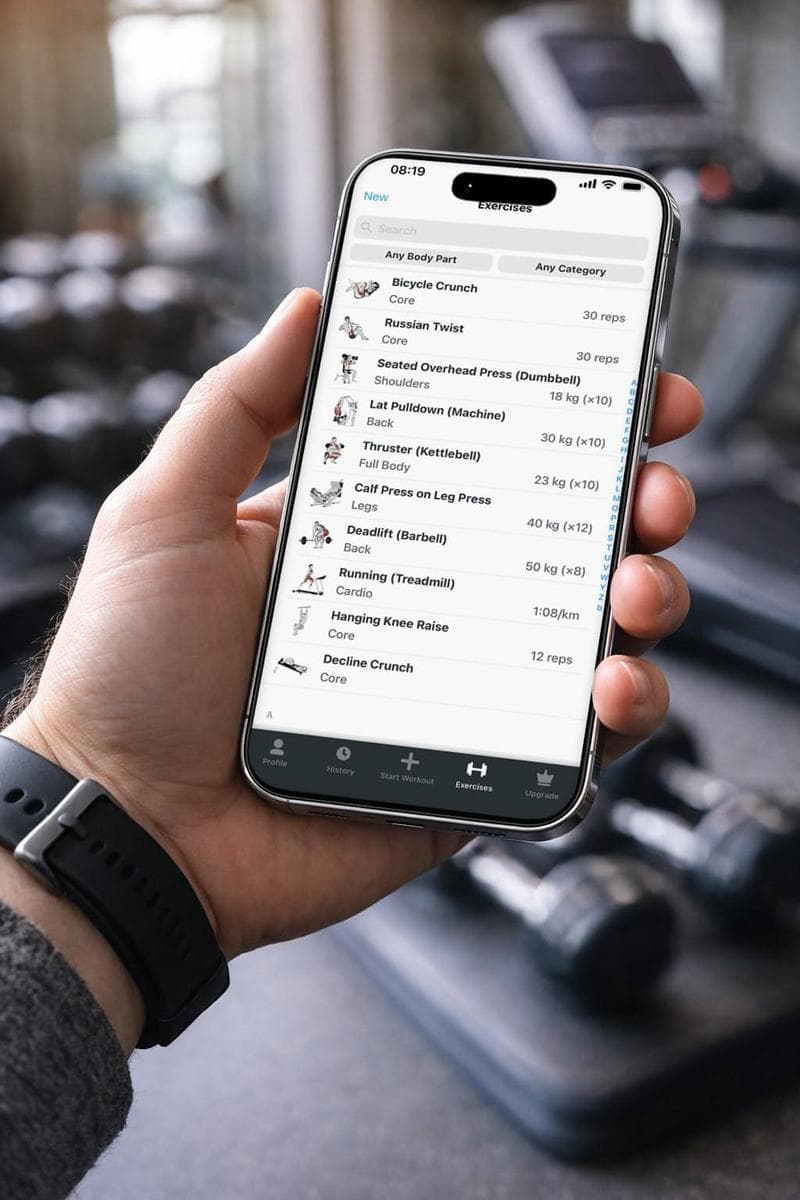
That's why the plan builder should live where your training data lives. When the same app logs your workouts and writes your plan, every session becomes feedback: weights that felt easy push the plan forward, skipped days pull it back to something sustainable.
What an app can't do (yet)
An app can't watch your squat depth or feel that your lower back is compensating. Form still comes from filming yourself, learning cues, and when in doubt asking a qualified human. And no app should override pain: if something hurts beyond normal muscle fatigue, that's a signal to see a professional, not to push through.
How to build your plan with fitleo
fitleo's coach is Leo, a conversational coach you simply chat with. There's no 40-field form: you tell Leo your goal, how many days you can train and what equipment you've got, and he builds a fully personalized program in the conversation.
- Download fitleo and answer Leo's first questions: goal, level, schedule, equipment.
- Leo builds your program: the right exercises, sets, reps and rest for your situation.
- Log your workouts in the app: logging is free and unlimited.
- Leo reviews every session and adjusts the plan week after week: more weight when you're cruising, a lighter week when life gets in the way.
Because Leo remembers your goals, constraints and history, the plan keeps evolving with you, closer to texting a coach than filling in a generator. Streaks and XP keep the habit alive between sessions, which is where most plans die.
Quick questions
Are app-generated workout plans actually good?
Yes, if the app collects real inputs (goal, level, schedule, equipment) and applies proven programming principles: compound lifts, appropriate volume, progressive overload. Good generated plans match template plans from human coaches, and beat them on adaptation, because they update with your training data.
Can a workout plan app replace a personal trainer?
For programming and day-to-day accountability, largely yes. For hands-on form correction or training around an injury, a qualified human is still the right call. Many people combine both: the app for the plan and the daily push, occasional coaching for technique.
Is there a free workout plan generator?
fitleo is free to download, and workout logging is free and unlimited. Generating fully personalized programs with Leo is part of fitleo+, which comes with a 14-day free trial, enough to build a plan and train on it before deciding.
How fast will I see results with a personalized workout plan?
Same as any well-built program: noticeable strength gains within 4–6 weeks, visible changes around 8–12 weeks with consistent training and reasonable nutrition. The real advantage is consistency: a plan that adapts to your life is easier to stick to.
Keep reading
- Coaching5 min read
Fitness Coach App: What It Does & If It's Worth It
What a fitness coach app really does, how it compares to a human trainer on cost and personalization, and how to spot a real coach vs a simple tracker.
- Programs5 min read
Beginner Gym Workout Plan: Start Simple, Get Strong
A simple beginner gym workout plan: 3 full-body sessions a week, 5 exercises, clear progression, plus how to walk into the gym without the anxiety.
- Progress5 min read
How Many Days a Week Should You Work Out?
How many days a week should you work out? For most people, 3–4 is the sweet spot. The honest answer by goal, plus full body vs split.