
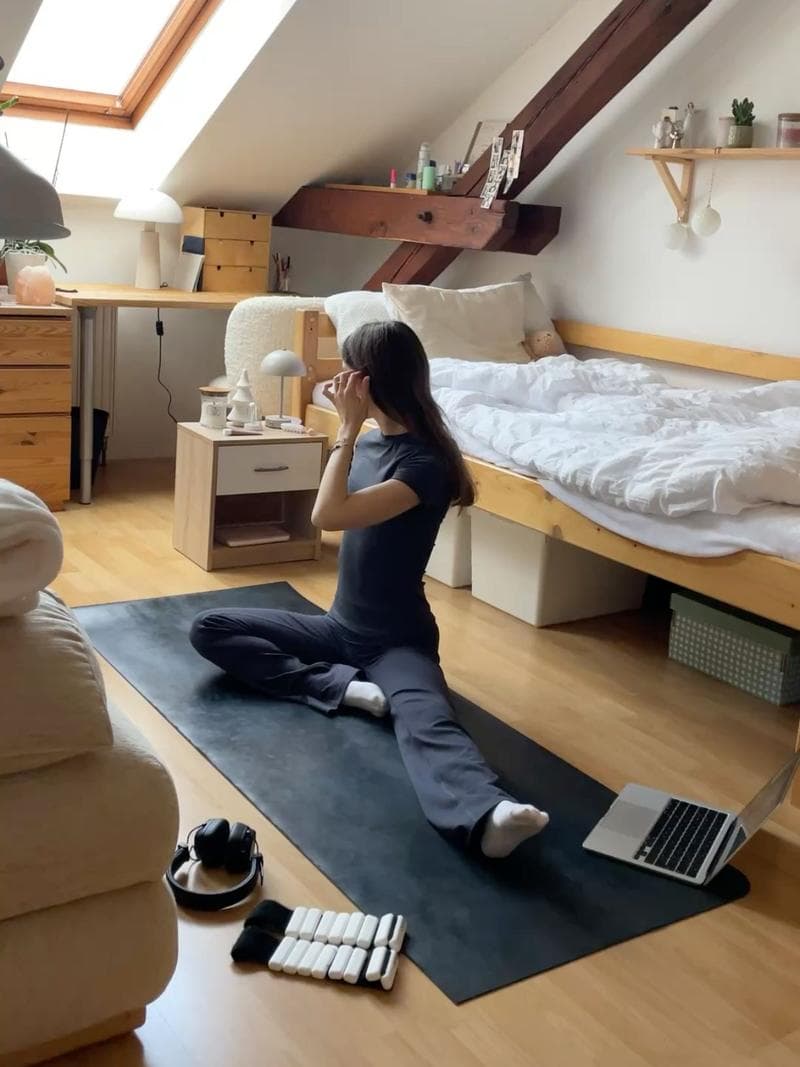
A home workout plan with no equipment can build real muscle, as long as you take your sets close to failure and keep making the exercises harder over time. Muscles respond to tension and effort, not to where you're standing: a hard set of push-ups doesn't know it isn't a bench press.
This guide covers the four movement patterns that work your whole body, a concrete 3-day weekly plan, the progression methods that replace adding plates, and an honest look at where bodyweight-only training hits its limits.
Can you really build muscle with bodyweight only?
Yes. Muscle grows when it's worked close to failure with enough weekly volume: a push-up taken to the last hard reps creates a stimulus very close to a press taken to the same point. Research keeps showing that effort and progression matter more than the tool: hard sets that keep getting harder grow muscle.
The honest caveat: bodyweight training has a ceiling. An advanced lifter chasing a maximal squat will eventually need external load, and legs are where reps climb awkwardly high first. But that ceiling is further away than most people think: a beginner or intermediate has years of progress available in their living room.
Leo's tip: stop treating the rep number as the goal. An easy set of 20 builds less muscle than a hard set of 12: judge every set by how close to failure it ends.
The movements that cover everything
You don't need forty exercises. Four movement patterns, each with easier and harder variations, cover the whole body:
- Push: push-up variations train chest, shoulders and triceps. Hands on a table if standard push-ups are too hard; feet elevated or archer push-ups when they get too easy.
- Legs: squats, lunges, split squats and step-ups. Single-leg work is the secret: a Bulgarian split squat stays brutally hard long after two-legged squats stop being a challenge.
- Pull: the honest weak point of home training. Rows under a sturdy table or towel rows around a door handle work, but they're fiddly. If you buy one thing, make it a cheap pull-up bar.
- Core: planks, side planks, dead bugs and hollow holds. No equipment, and they progress by time and leverage instead of load.
Every session in the plan below hits all four patterns: that's what makes it a program, not a list of exercises.
A concrete 3-day home workout plan
Three full-body sessions a week, 30–40 minutes each, with at least one rest day between them. Rest 2–3 minutes between hard sets, and finish every set 1–2 reps short of failure.
Day 1
- Push-ups: 3 sets, as many clean reps as you can minus 1–2 (elevate your hands if needed)
- Bodyweight squats: 3 × 15–20
- Table rows or towel rows: 3 sets, as many clean reps as you can
- Reverse lunges: 3 × 10 per leg
- Plank: 3 × 30–45 seconds
Day 2
- Pike push-ups: 3 sets close to failure
- Bulgarian split squats (rear foot on a chair): 3 × 8–12 per leg
- Towel rows: 3 slow, controlled sets
- Glute bridges: 3 × 15–20
- Dead bugs: 3 × 10 per side
Day 3
- Decline push-ups (feet on a chair): 3 sets
- Walking lunges: 3 × 12 per leg
- Pull-ups if you have a bar, rows if you don't: 3 sets
- Single-leg glute bridges: 3 × 10 per leg
- Side planks: 3 × 20–30 seconds per side
Too hard? Step down a level. Sailing past the top of a rep range? Step up. The plan is a starting point, not a prison.
How to progress without weights
In a gym you add plates. At home you have five other levers. This is progressive overload without a barbell:
- Harder variations: knee push-up → standard → decline → archer; squat → split squat → Bulgarian split squat. The biggest lever by far.
- Tempo: a 3-second lowering phase turns an easy exercise into a hard one without changing anything else.
- Range of motion: deficit push-ups with hands on books, deeper lunges, a longer pause at the bottom.
- More reps and sets: useful up to roughly 15–20 reps; past that, switch variation instead of grinding out 30.
- Density: same work in less time by trimming rest periods, once your form is solid.
Pull one lever at a time and write down what you did. Progression you don't track is progression you can't repeat.
When home training stalls (and what to do)
The first stall is physical: reps creep past 20 and sets start feeling like cardio. The fix is never more reps: it's a harder variation, a slower tempo or single-limb work that brings the set back under 15 hard reps.
The second stall kills more home programs: skipped days. No gym to walk into means no friction, but no ritual either: sessions quietly dissolve into "later". Anchor workouts to a fixed time, and treat consistency as the real goal for your first two months. The plan only works if it happens.
How fitleo runs your home training
fitleo's coach is Leo: tell him you train at home with no equipment, and he builds the program around exactly that. Gym, home or outdoor: he adapts to whatever you have, including nothing at all.
- Download fitleo and tell Leo you're training at home with no equipment. That's all he needs.
- Leo builds a bodyweight program at your level, and guided sessions walk you through it exercise by exercise.
- Log your reps as you train: logging is free and unlimited, bodyweight sets included.
- As your logged reps climb, Leo moves you to harder variations: the progression happens for you.
Home training rarely dies from bad programming. It dies from skipped days. Streaks and XP give every session a reason beyond the workout itself, and Leo notices when you go quiet. Get access to a gym or dumbbells someday? Tell him: the program follows your equipment, not the other way around.
Quick questions
Can I build muscle at home without equipment?
Yes. Muscle responds to sets taken close to failure with enough weekly volume: push-ups, squats, lunges and rows cover the whole body. The honest limit: advanced lifters chasing maximal strength eventually need external load, but beginners and intermediates have years of progress with bodyweight alone.
How many times a week should I do bodyweight workouts?
Three full-body sessions a week works for most people: enough volume to grow, enough recovery in between, and a schedule that survives real life. Two is the effective minimum; four or five can work if sessions are shorter and you recover well.
What's the best app for home workouts without equipment?
fitleo is built for this: tell Leo, your coach, that you train at home with nothing, and he generates a bodyweight program with guided sessions, then moves you to harder variations as you progress. Logging is free and unlimited; personalized programs are part of fitleo+, with a 14-day free trial.
Do I need any equipment at all?
No. The plan in this guide works with a floor, a wall, a chair and a towel. That said, a pull-up bar is the single best cheap addition: pulling is the weak point of equipment-free training, and a doorway bar fixes it for the price of a pizza.
Keep reading
- Programs5 min read
Beginner Gym Workout Plan: Start Simple, Get Strong
A simple beginner gym workout plan: 3 full-body sessions a week, 5 exercises, clear progression, plus how to walk into the gym without the anxiety.
- Progress6 min read
Progressive Overload: The Complete Guide to Real Gains
What progressive overload really means, the levers ranked, how fast to progress, and how to break a plateau when the weights stop moving.
- Coaching6 min read
How to Stay Consistent With Working Out: A Real System
How to stay consistent with working out: ditch motivation as fuel, shrink your plan, track wins and never miss twice. A system that survives real life.